

Recorded conversations and interviews on electronics design and manufacturing with the editors of PCD&F/Circuits Assembly, brought to you by the Printed Circuit Engineering Association (PCEA)
Episodes
Sunday Nov 27, 2022
Sunday Nov 27, 2022
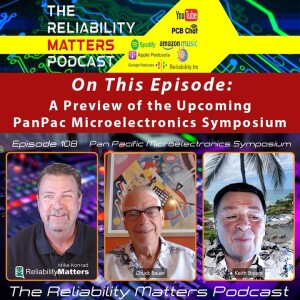
SMTA is well known for producing high-quality relevant technical conferences and symposiums. This includes, among others, the technical conference held at SMTAI, the High Reliability Cleaning and Coating Conference, the Symposium on Counterfeit Parts and Materials, the Advanced Electronics Assembly Conference, the Wafer-Level Packaging Symposium, the Electronics in Harsh Environments conference, and the Pan Pacific Microelectronics Symposium, often referred to as Pan Pac.
Pan Pac is unique in many ways, beginning with its venue. Pan Pac is held annually at one of the Hawaian islands. This fact alone makes this symposium stand out. But there are many other factors that make this symposium unique. As Pan Pac’s steering committee says:
"The Pan Pacific Microelectronics Symposium strives to build bridges and nurture relationships across all boundaries, oceans and cultures, industries and technologies, companies and individuals. Its location in Hawaii always provides the requisite isolation from day-to-day distractions necessary to support these goals and enhance personal face to face interactions. The Pan Pacific continues its mission of building the vision and future directions for the electronics industry!"
Pan Pac 2023 is scheduled for January 30 - February 2, 2023, at the Sheraton Kauai Resort on the island of Kauai.
To talk more about the upcoming Pan Pacific Symposium, Mike Konrad invited two colleagues who are instrumental in curating the technical contact for this symposium. Dr. Chuck Bauer, one of the creators of this symposium, and Keith Bryant join him to discuss the conferences technical tracks and presentations as well as their view on what makes this conference unique.
Tuesday Nov 08, 2022
Tuesday Nov 08, 2022
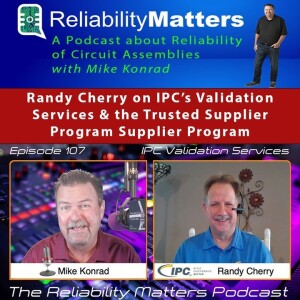
Like most manufacturers, the electronics manufacturing industry relies on countless suppliers to fulfill its manufacturing needs. I'm quite certain there is no one within the EMS space who fabricates their own boards using materials produced in house, operates their own semiconductor foundries, designs and manufacturers their own components, and produces soldering materials for their reflow process.
Our industry relies on a vast network of manufacturers throughout the world to build even the simplest electronic assembly. Intellectual property security, cybersecurity, national security, are all hot topics today. No one wants their hard-earned intellectual property stolen. This is most true within the US military establishment. There are, at present, numerous policies, procedures, and regulations designed to protect various parts of our supply chain from unscrupulous people and companies. Today, companies are concerned about “controlled unclassified information” (CUI) and “controlled technical information” (CTI).
That brings us to IPC-1791. What is IPC-1791?
Randy Cherry, Mike Konrad's guest on this episode, explains.
Randy Cherry has over 30 years' experience in engineering and is a certified SMT process engineer and an IPC auditor. He is director of Validation Services at IPC. Validation Services is a series of certification programs that qualify products and processes to the IPC industry standards.
Tuesday Oct 25, 2022
Tuesday Oct 25, 2022
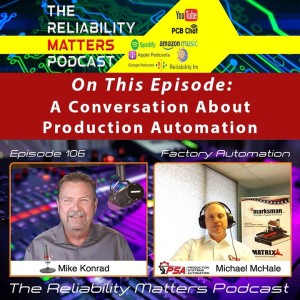
It's been said on this show that one key factor to international competitiveness is automation. While labor rates vary widely across the world, automation helps to level the field.
Michael McHale is CEO of Production Systems Automation, otherwise known as PSA. He graduated from Drexel University with a BS degree in mechanical engineering.
PSA is a privately owned engineering and custom manufacturing firm founded in 1985, with three locations in Pennsylvania. They are experienced as a turnkey systems integrator, providing solutions for capital projects including, but not limited to; flexible robotic solutions, custom automated machinery, drives and controls & custom PLC projects. They also offer a line of standard products developed for industry specific customers. They are a robotic systems integrator at heart, representing leading global robotic OEMs.
He joins Mike Konrad on Reliability Matters.
Monday Oct 17, 2022
Monday Oct 17, 2022
Last July, Indium Corporation announced a partnership with SAFI-Tech, an Iowa-based startup that is creating no-heat and low-heat solder and metallic joining products.
They call these supercooled molten metal products, and they have direct application to electronics soldering.
Dr. Ian Tevis, SAFI-Tech’s president and co-founder, and Dr. Andy Mackie of Indium Corporation, discuss this supercooling platform and what’s next toward bringing it to market with PCEA president Mike Buetow.
Monday Oct 17, 2022
Monday Oct 17, 2022
Today we’re diving into conformal coating best practices. With the explosion of IoT, the electrification of vehicles, and the miniaturization of circuit assemblies and associated components, many of which are operating in harsh environments, the need for conformal coating has never been greater.
Coating your assemblies? Where does one start? What material should one choose? Should it be applied in-house or through a contract-coating house? What are the best practices in materials selection, application, inspection, and thickness? So many questions!
To answer these and other questions, Mike Konrad invited a conformal coating expert to shed light on this subject. David Greenman began his career in the conformal coating business at Concoat distributing Humiseal products and eventually manufacturing them under license for Europe, the Middle East, India and Africa. After 25 years of distributing and manufacturing Humiseal products, Chase Corp, which owns Humiseal purchased Concoat. David now serves as director of Humiseal UK, Europe and India, responsible for corporate responsibility as well as supporting HumiSeal sales and technical teams.
He is qualified as a radio, TV/electronics engineer and a member of The Society of Radio and Electronics Technicians, now the Institution of Engineering and Technology.

Tuesday Sep 27, 2022
Tuesday Sep 27, 2022
Wang Lu is cofounder of Jove Enterprises, a China-based printed circuit fabricator with five facilities in mainland China and one pending in Thailand. She discusses the company's technical strengths and markets, and reasons for branding out to Thailand, with PCEA president Mike Buetow.
Tuesday Sep 20, 2022
Tuesday Sep 20, 2022
Modern electronics assembly has seen so many changes over the years. In today’s era of IoT, the electrification of vehicles, the explosion in the use of bottom terminated components, the increasing implementation of electronics into harsh environments have all contributed to the increasing complexity and difficulty of building electronics. While so much has changed, there are some things that have remained the same.
One such thing is the need for ESD control. There always was and continues to be the challenge of protecting components from the dangers of static electricity. My guest today is Thomas Ricciardelli, founder and CEO of SelecTech, a manufacturer of ESD flooring for the electronics assembly industry.
Tom is also the chairman of the Flooring Committee of the EOS/ESD Association. Tom earned a master's in chemical engineering from MIT and an MBA from the MIT Sloan School of Management.

Tuesday Sep 13, 2022
Tuesday Sep 13, 2022
Stephen Chavez spent the past 12 years as a principal engineer and global subject matter expert of PCB design for Collins Aerospace and Raytheon. This year, he joined Siemens as a senior product marketing manager, where he focuses on methodologies for adopting a strategy for resilience and integrating the Design-to-Source Intelligence insights from Supplyframe.
He speaks with PCEA president Mike Buetow about automation in design, from autorouting to integrating component data in a timely fashion, to reduce design time.
Tuesday Sep 13, 2022
Tuesday Sep 13, 2022
Today, Mike Konrad talks about low-volume electronic assembly. We all know who the “big players” are when it comes to solder paste printers, pick-and-place machines, reflow ovens and other assembly equipment. But what choices does one have if they need to produce low volumes of electronic assemblies such as prototypes and other low-volume applications?
Let’s face it, most assemblers can’t justify a multi-million-dollar production line for low-volume production. One solution may be to outsource the production to a contract manufacturer but there are specific circumstances which may prevent that. In today’s episode, we’ll review some of the equipment options for low-volume SMT production and we’ll see if the barrier to entry for in-house assembly is lower than one might think. Mike's guest today is Ed Stone.
Ed is a sales manager at Manncorp, a provider of SMT assembly equipment for the EMS industry. Manncorp was founded 55 years ago back in 1967. Just imagine how much our industry has changed over the past 55 years!
Tuesday Aug 23, 2022
Tuesday Aug 23, 2022
Today, we're going to talk about contract manufacturing. Do you have a circuit assembly that needs to be built? Don’t have the equipment in-house or enough bandwidth or specialized expertise to build it? You may be best served by utilizing the services of a contract manufacturer.
Contract manufacturers come in all shapes, sizes and capabilities. Should I seek out a Tier 1 manufacturer? How about Tier 2, 3, 4? What does tier stand for anyway? should I have my assemblies built overseas or in-country? What about issues such as ITAR? Who will be providing the components? What if I need more than just boards assembled such as design, testing and box build?
To answer these and so many more questions Mike Konrad turns to his friend and colleague David Raby. David is the President of STI electronics, founded in 1982 by David's father the late Jim Raby. Those of you who have been around the electronics industry for some time will know Jim Raby for his work with the US Navy in establishing military standards for electronics manufacturing and the development of the NASA and Department of Defense Soldering Schools.
Over the past 40 years, STI Electronics has expanded its focus from consulting and technical seminars to providing training, laboratory analysis, advanced research and development, microelectronics assembly, prototyping, and small to medium volume PCB contract assembly for the electronics industry.
David graduated from Auburn University with a bachelor’s degree in Aviation Management.